Monday, April 14, 2014

Fr. William Stoeger, SJ 1943-2014


Bill Stoeger has passed away. His obituary is here.
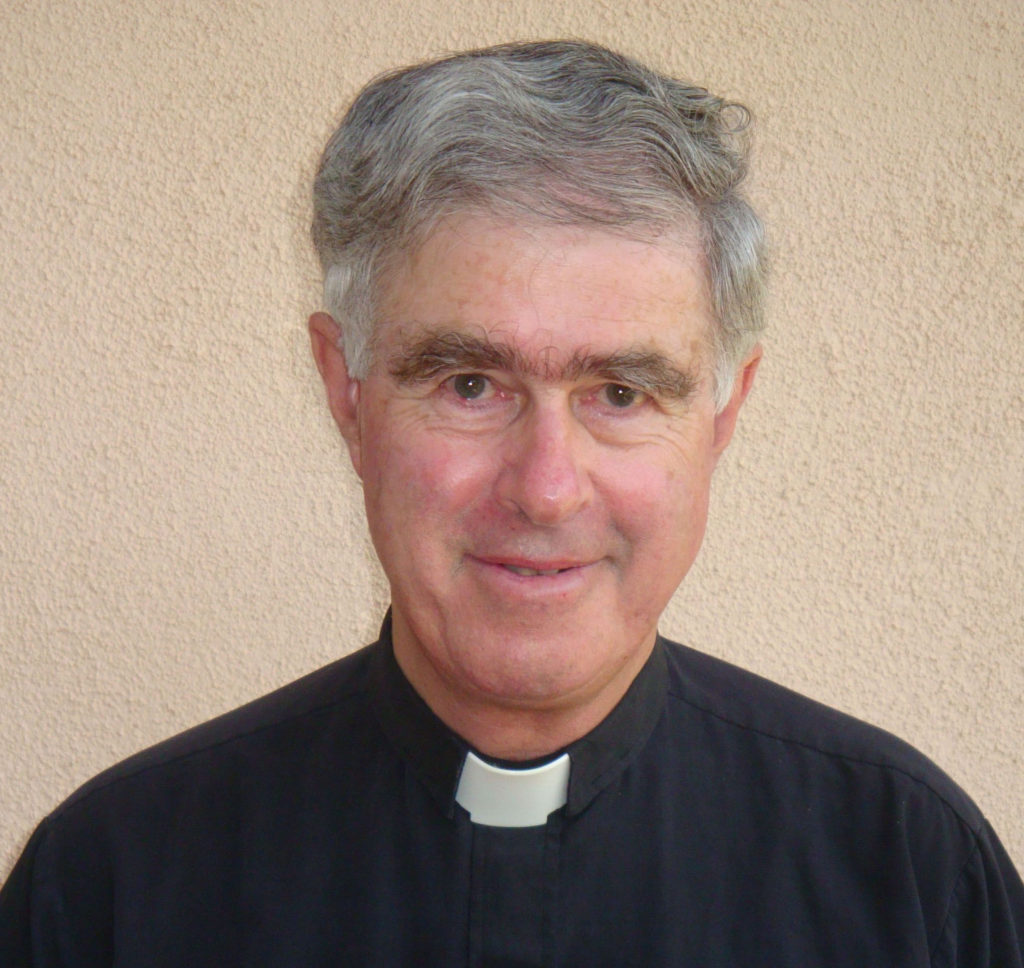
Jesuit Father William R. Stoeger, 70, an astronomer at the Vatican Observatory in Arizona, died March 24 at the Sacred Heart Jesuit Center in Los Gatos, Calif., following a struggle with cancer. A funeral Mass for the priest was scheduled for March 28 in Los Gatos. He had been a Jesuit for 52 years. (CNS photo courtesy of the Vatican Observatory Foundation)I first met Bill via my doctoral thesis supervisor (James Pambrun, St. Paul / Ottawa) and Bill served as the external examiner for my thesis. Bill was an extraordinary man, combining the pastoral gifts he developed as a Jesuit with spectacular talent as an astrophysicist. His scientific training was conducted - in part - at Cambridge, where he worked with Stephen Hawking, among others.

Over the years, Bill and I exchanged a number of emails and met at several conferences, among which included a Catholic Theological Society of America meeting in 2003 and a Vatican Observatory / CTNS conference in 2003 at Castel Gandolfo. Bill was encouraging me to lead a project of contributions on Catholic interpretations of scientific anthropology (evolutionary psychology and so forth) despite the obstacles that lay in my path.

Bill was a generous scholar and priest. He was not given to any of the pretense that marks so many academics. He was enormously well respected by the scholars with whom he worked in the science-faith dialogue, being one of the first to call for a greater philosophical depth to the exchanges. He was also well known as one of the first to call for greater Catholic participation in the science-theology dialogue. Bill was a remarkable person. May he now enjoy the fullness of God's grace. R.I.P. Bill.

Wednesday, March 19, 2014

Just ordered Nagel's book (finally)

This book by Thomas Nagel, titled Mind and Cosmos: Why the Materialist Neo-Darwinian Conception of Nature Is Almost Certainly False. I will read this when spring officially makes its mark locally... which is set to happen after spring makes its mark calendrically  - sadly.

The reviews of it have been everywhere for quite some time. Love this review from Michael Chorost in the Chronicle in which he reports on the snarky comments of the strangely ideological Jerry Coyne and others before summing up the difficulties Nagel has uncovered c/o Joan Roughgarden, which seem to me spot on:

"I mean, these guys are impervious to contrary evidence and alternative formulations," she says. "What we see in evolution is stasis—conceptual stasis, in my view—where people are ardently defending their formulations from the early 70s."
And here is the ever great H. Allen Orr, in the NYRB on Nagel's book. Can't wait to read it myself.

Monday, February 17, 2014

Douthat on Gopnik on Hart

in today's NYT. Douthat is, as usual, on the mark... but it does make me want to read Hart's book!

Wednesday, December 11, 2013

Pope Francis and unfettered capitalism

Sigh. Saw this one coming. Pope Francis has been excoriated for taking on 'unfettered capitalism' - by Rush Limbaugh, the US Republican party pundits and various others who think they detect in Francis a simple-minded Marxist.

Sigh. Haven't we seen this movie before? Why, yes we have, and Francis is only extending the analysis of previous pontiffs, whom certain defenders of capitalism are pretty fond of.

And if you think contemporary capitalism is just fine thank you, take it from a Canadian business journalist: it's not - in a Very Important Way.

P.S. Breaking news (ahem): Pope Francis is Time's person of the year. Now, assuming people still read Time, I guess this is meaningful. Good analysis here at CMT: NOT the people's Pope, something more... 

P.P.S.: More unfetteredness here, of which more examples ad nauseam could be retrieved off the internet.

Friday, November 1, 2013

Beep beep: from theology to cars

Ben Myers pulls a slam dunk, in his own diminutive style.

The Humanities

Pity the humanities. Enrollment in post-secondary humanities programmes is down to around 7% of the total student population in the U.S. (in Canada, it's only slightly higher if memory serves) and here is a nice NYT article (if one can use the word 'nice' in this context) that details some of the current discussion on the state of the humanities. Of which there is much discussion... From the end of the article comes this analysis which I wish had received more attention throughout:

But for students worrying about their own future, Shakespeare can seem an obstacle to getting on with their lives.
“Students who are anxious about finishing their degree, and avoiding debt, sometimes see the breadth requirements as getting in their way,” said Nicholas Dirks, chancellor of the University of California, Berkeley.
Many do not understand that the study of humanities offers skills that will help them sort out values, conflicting issues and fundamental philosophical questions, said Leon Botstein, the president of Bard College.
“We have failed to make the case that those skills are as essential to engineers and scientists and businessmen as to philosophy professors,” he said.
 This coheres with an observation that was made by Stefan Collini in his book, What are Universities for? a year or two ago and which I quoted in a recent paper on the relationship between Christian faith and the university:
  
“it is not the subject-matter itself that determines whether something is, at a particular moment, classed as ‘useful’ or ‘useless’. Almost any subject can fall under either description.”  (Collini, 55)
In other words: Theology, English, Philosophy and Linguistics can launch a career in any number of fields, because the skills acquired in these disciplines has to do with deepening the general knowledge, perception and honing of insights that will benefit the individual generally speaking. It is for this reason why we must push back against over-specialization, especially in the humanities, because it is that circumstance that the humanities would loses their collective humanity, and therefore their timeless relevance.

Tuesday, September 10, 2013

Quebec's descent into madness

Here's where we're going here in Quebec. Loony tunes time folks - the government is trying to overthrow constitutional law and human rights...

Tuesday, August 27, 2013

Assessing Joseph Bottum

The former editor of First Things has created a stir with his tepid - and strategic - endorsement of the idea that same-sex marriage ought not to be fought in the trenches. He sees the Catholic Church's opposition to the idea as ill-tempered and self-defeating. In response, Rusty Reno's reflections of the other day are on the mark in my view (his opinions being important as he is Bottum's successor at FT), but so are the more temperate remarks of Ross Douthat in today's Times.

Wednesday, August 14, 2013

Creativity: The Missing Element within the contemporary academy

A nice post from Helen deCruz at newapps blog today. Certainly a good antidote to what I see all around me: the tendency to know more and more about less and less, funded to a (now) lesser extent by research grants. All a sad testimony to the current state of university life: no core curricula, students ill prepared to write in coherent English and many ideologically predisposed university programmes that are either geared to bean counting careers or fighting some imaginary emancipatory struggle in a jargon few if any comprehend.

Ok... that's off my chest.

Helen's question about Tolkien is right on the money because his imaginary capacity had as its chief orientation the transcendent as well as the struggle between good and evil, both of which are thought by many inside the contemporary university to be entirely passé. No kidding - I've met faculty and students who speak this way...

Thursday, August 1, 2013

Robert Bellah and deconstructionism

A short reference to a tale told here in a FT blog entry on the recent passing of Robert Bellah, sociologist of religion extraordinaire. In this briefest of discussions of Bellah's work and influence, a telling description of a conversation Bellah had with one of his grad students. Here is that excerpt:

There is a deep and keen moral sense in his work that deserves to be celebrated, especially in an era of postmodernist moral insouciance. One wants to stand up and cheer when reading, in his essay “The True Scholar,” of an exchange with one of his best graduate students, who argued that all human action is motivated by the struggle to increase one’s power and possessions. To which Bellah offered the perfect rejoinder. “Is that true of you?” he asked. “How could I ever trust you if that were true?” How much fashionable nonsense could be disposed of by teachers willing to pose those same simple questions, and thereby reassert the moral importance of their own work.
This is what philosophers call the performative contradiction involved in so much postmodernist thought - at least of the deconstructionist variety. That is: one's claimed belief in something being contradicted utterly by one's life as it is lived.

RIP Robert Bellah.

Monday, July 22, 2013

Original Sin: A Short Typology of Views

I recently gave a short paper at a conference of grantees associated with the Evolution and Christian Faith programme of the Biologos Foundation. In it, I sorted out certain of the elements present in the theologies of original sin of Augustine and Barth, while proposing some kind of constructive confluence of these theologians. This '3rd. option' as I termed it, is a mixture of elements taken from Augustine and Barth, but which excludes certain other elements.

For example, a contemporary view of original sin would exclude Augustine's commitment to an individual human male Adam, yet could accommodate a certain concept of inherited or (preferably) infection of human nature by sin. Such a view could take from Barth his realistic interpretation of the Genesis creation narrative as saga, but question Barth's overly rigorous view of sin as 'nothingness' since it is clear from an evolutionary perspective that many human sins do indeed have physical causes.  

This material is being worked up in a paper and eventually will be incorporated into a forthcoming monograph.